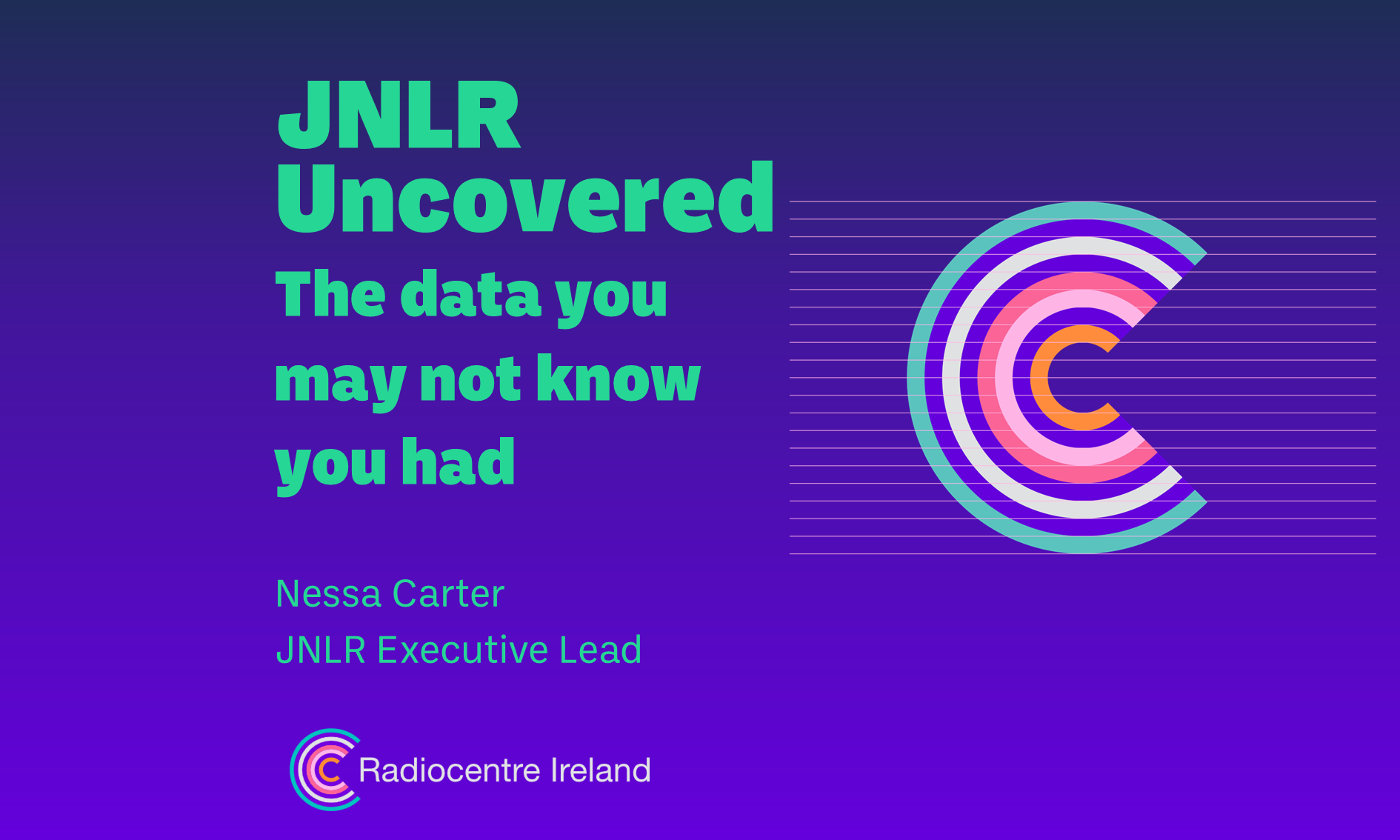
This Radiocentre Ireland webinar featured Nessa Carter, JNLR Executive Lead, explore underused JNLR data showing how people listen to radio, not just how many listen. It focused on weekday listening to any radio, with particular emphasis on digital device usage across the day.
The key message was that while FM radio remains dominant, digital listening is now a significant and growing part of radio consumption. Around 3.5 million adults listen to radio every weekday, with FM still accounting for the vast majority of listening. However, more than half a million adults listen to radio on a digital device every day, including mobile phones, smart speakers, PCs/laptops and connected TVs.
Digital listening is especially important among younger audiences. Among 15–24s, 15% listen to radio on a digital device daily, and around one in ten listen only via digital devices, with no FM listening. For 15–34s, digital accounts for 17% of radio listening minutes, compared with 12% for all adults. Mobile is particularly important for younger listeners, while smart speakers deliver strongly across all age groups.
A major insight was that different devices behave differently throughout the day. Smart speakers tend to mirror FM radio behaviour, peaking in the morning and being tied to fixed locations such as kitchens, bedrooms or offices. By contrast, mobile listening has a more distinct pattern, with peaks around commuting times and stronger performance in the evening. This suggests mobile connects radio to the listener rather than to a location.
The evening was highlighted as a major opportunity. Traditionally, radio listening declines from around 5pm or 6pm as people move into other media. However, digital listening, particularly among under-35s, holds up much better after 7pm. For 15–34s, digital can account for more than a third of radio reach in some evening quarter-hours. This points to changing media habits, more solo listening, and greater opportunity to reach audiences who may also be consuming other forms of audio.
The webinar also showed that device-level data can be examined by programme, time block and station, subject to sample size. This allows broadcasters to understand not just how many people listened to a programme, but whether they listened via FM, mobile, smart speaker or another device.
In the Q&A, Nessa explained that this data can help stations think more carefully about discovery, promotion and listener behaviour at different times of day. The session also touched on connected car listening, which is not yet separately measured in detail but is being actively explored by the JNLR committee.
Finally, the webinar outlined future work with Ipsos and GfK to combine JNLR demographic data with first-party IP server-log data from broadcasters. This proof-of-concept project aims to create a more complete picture of FM and digital listening while preserving the strength of the JNLR’s people-based measurement.
Click the buttons below to download the presentation deck and view the webinar.