A recent report from Cumulus Media and Signal Hill Insights provides one of the most detailed examinations to date of how U.S. podcast consumers behave—how they listen and watch, discover content, move across platforms, engage with hosts, and respond to advertising. Based on a nationally representative sample of weekly podcast users, the report paints a picture of a medium defined by intentionality, habit, and deep trust, even as the ecosystem becomes more hybrid with the growth of video-enabled podcasts.
Immediate, Intentional and Habitual Consumption
Podcast listening remains an intensely deliberate behaviour. The report shows that 78% of weekly podcast users consume new episodes within the first 24 hours, rising above 80% among heavy listeners—those consuming 6+ hours per week. This immediacy demonstrates high emotional investment and routine-like behaviour around favourite shows.
Engagement is not limited to new episodes. 57%of weekly listeners go back to earlier episodes when starting a new show,with this behaviour especially strong among Podcast Pioneers—those listening for 4+ years—and among women. These groups are also more likely to revisit episodes they may have missed. This backward listening behaviour reinforces podcasts’ status as on-demand narrative ecosystems rather than episodic, one-off experiences.
Listening is primarily solo. Even among households with children—where shared listening is slightly higher—podcasting remains a personal, opt-in medium. Perhaps because listeners choose podcasts themselves, sensitivity to unsuitable language or graphic content is low:69% have no issue with content that might be objectionable on linear media, and most disagree that strong language or graphic True Crime content would make them turn a podcast off.
Content Format: Narrative vs.“Chatcast”
The rise of video-enabled podcasts has sharpened the divide between content types. Narrative formats—documentary-style storytelling—continue to perform especially well among audio-only listeners. Meanwhile, audiences who prefer video gravitate to “chatcast” formats, conversational shows built around hosts or panels. Data shows that time spent listening is nearly 50/50 across the two formats overall, but the presence of video strongly increases the appeal of chat-based podcasts.
Audio Still Dominates, Even on YouTube
Although video continues to grow, audio behaviour remains dominant:
This reveals that even when presented as a video, the primary use case remains audio-first. The preference for minimised video is strongest among younger listeners and Podcast Newcomers, who enjoy the flexibility of listening while multitasking.
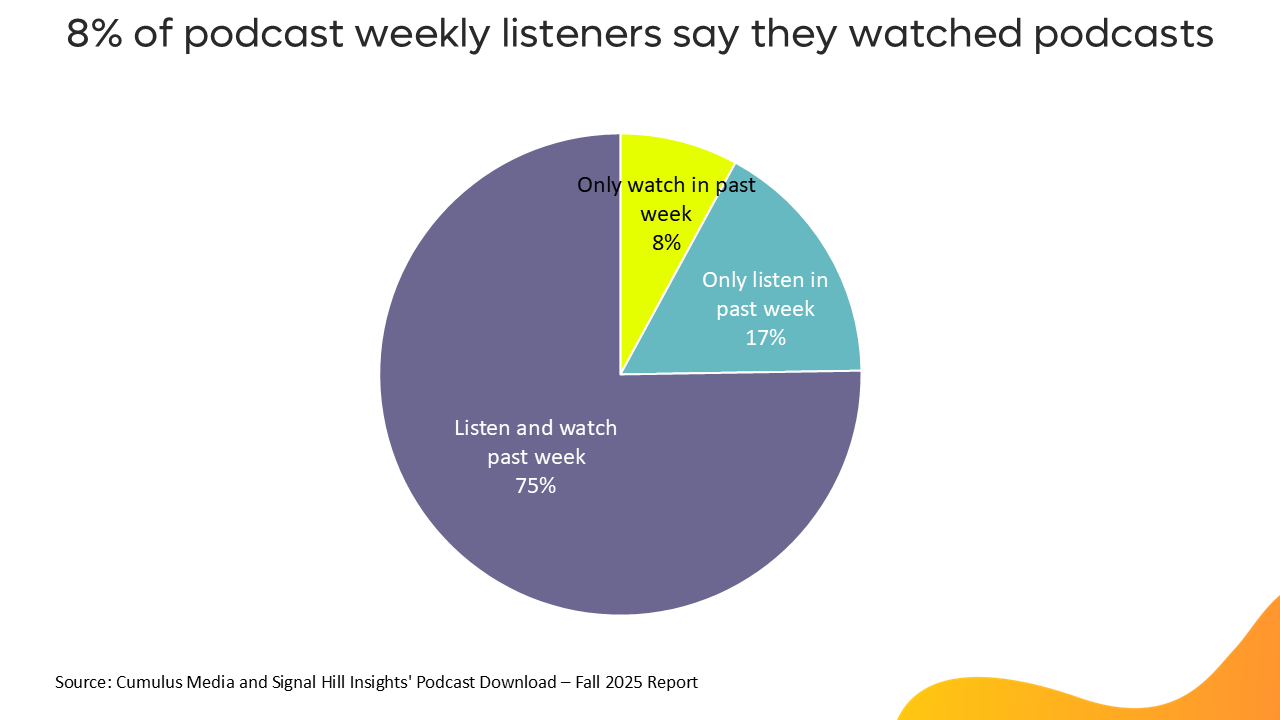
Importantly, watching podcasts displaces other media. Overall, 48% say watching podcasts replaces TV time, increasing to 45% among 18–34s for TV alone, and even higher when including social video and YouTube. This demonstrates the medium’s growing share of attention traditionally held by television and streaming platforms.
Platforms: YouTube Leads, But the Ecosystem Is Fragmented
The platform landscape continues to evolve rapidly:
In terms of time spent listening, almost three quaters of minutes listened is spent with YouTube.
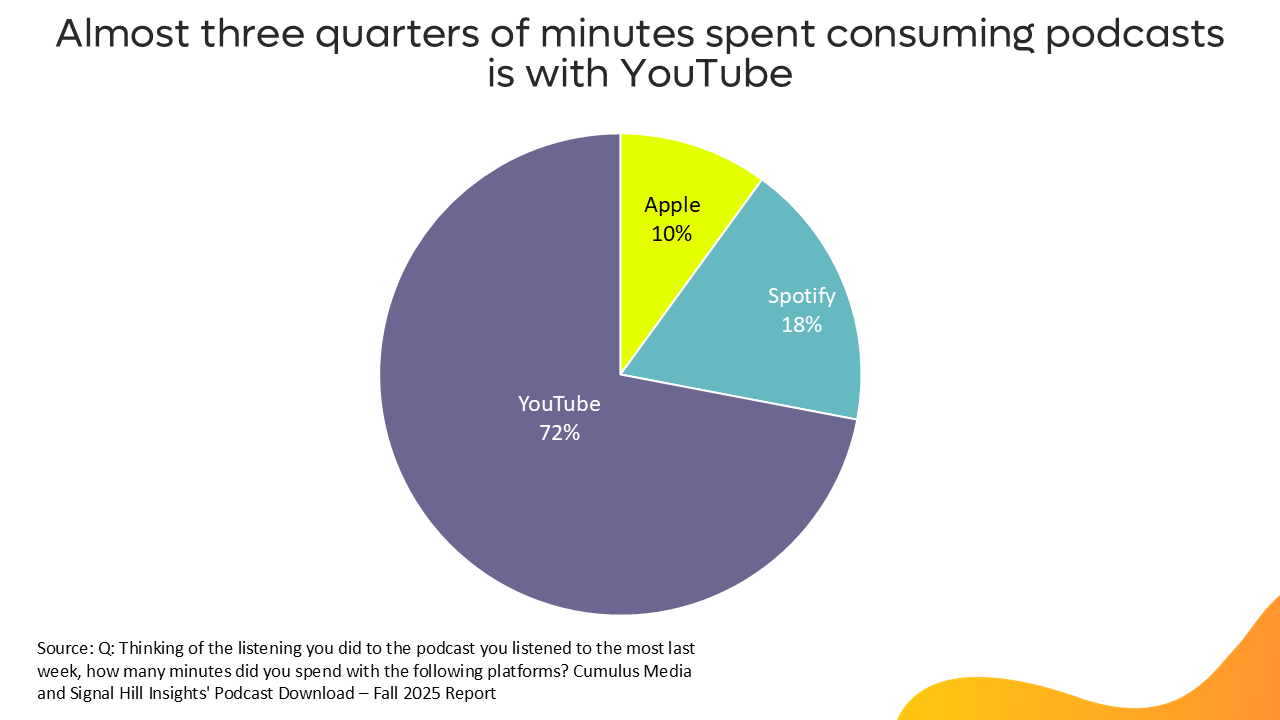
Despite YouTube’s scale, the behaviour is not exclusive. Half of YouTube podcast consumers also listen to the same shows on other platforms, often because they are in environments where video isn’t feasible (e.g., driving, exercising). Moreover, 70% say they would switch platforms if their favourite show left YouTube—strong evidence that content, not platform, drives loyalty.
Discovery: YouTube Is the New Search Engine for Podcasts
YouTube has become the top engine of podcast discovery:
Devices and Locations: Audio-Only Users Are More Mobile
Those who prefer audio-only are more likely to consume podcasts:
Video-preferring audiences are more likely to watch on a smart TV or laptop and to consume podcasts at home. This divergence underscores that format preference maps closely to device and situational behaviour.
Advertising: Host Influence and AdReach
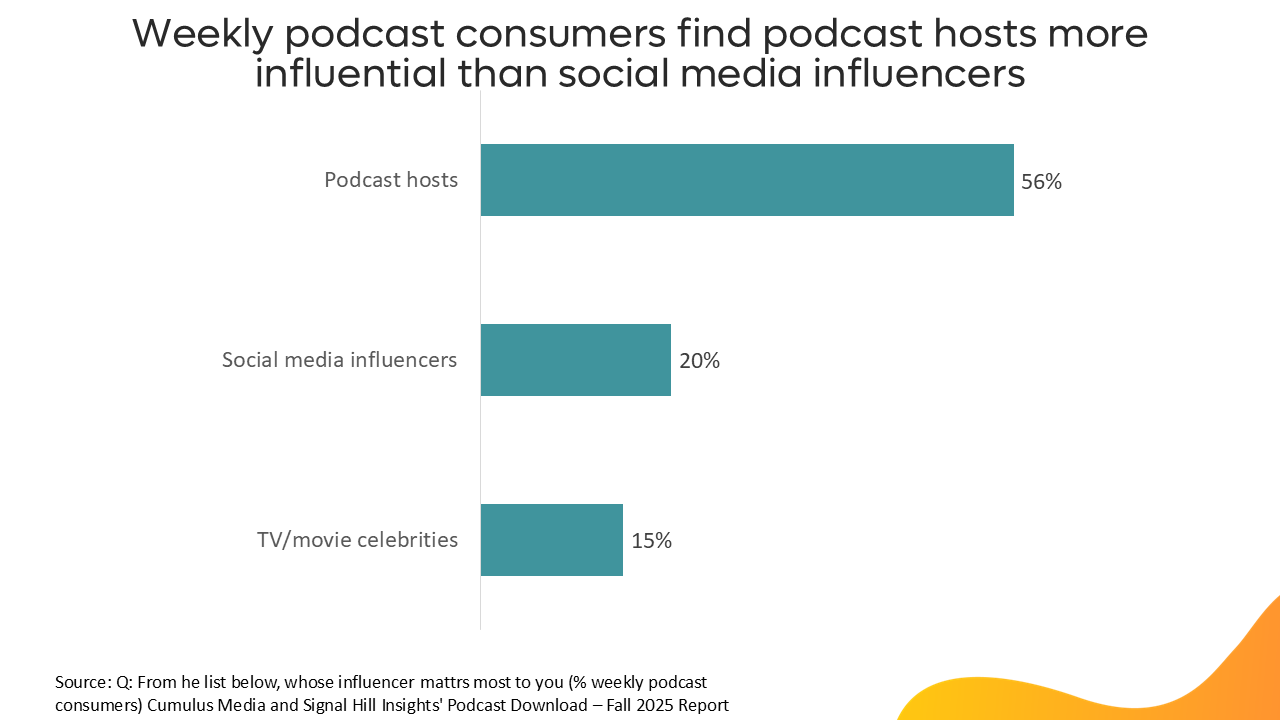
One of the most striking findings is the scale of host influence.
Podcast hosts are rated:
This influence comes from the intimacy of long-form listening, the personal relationship built over time, and the authenticity of host-read ads, which often feel like recommendations rather than interruptions.
Podcasts also excel at reaching hard-to-reach audiences
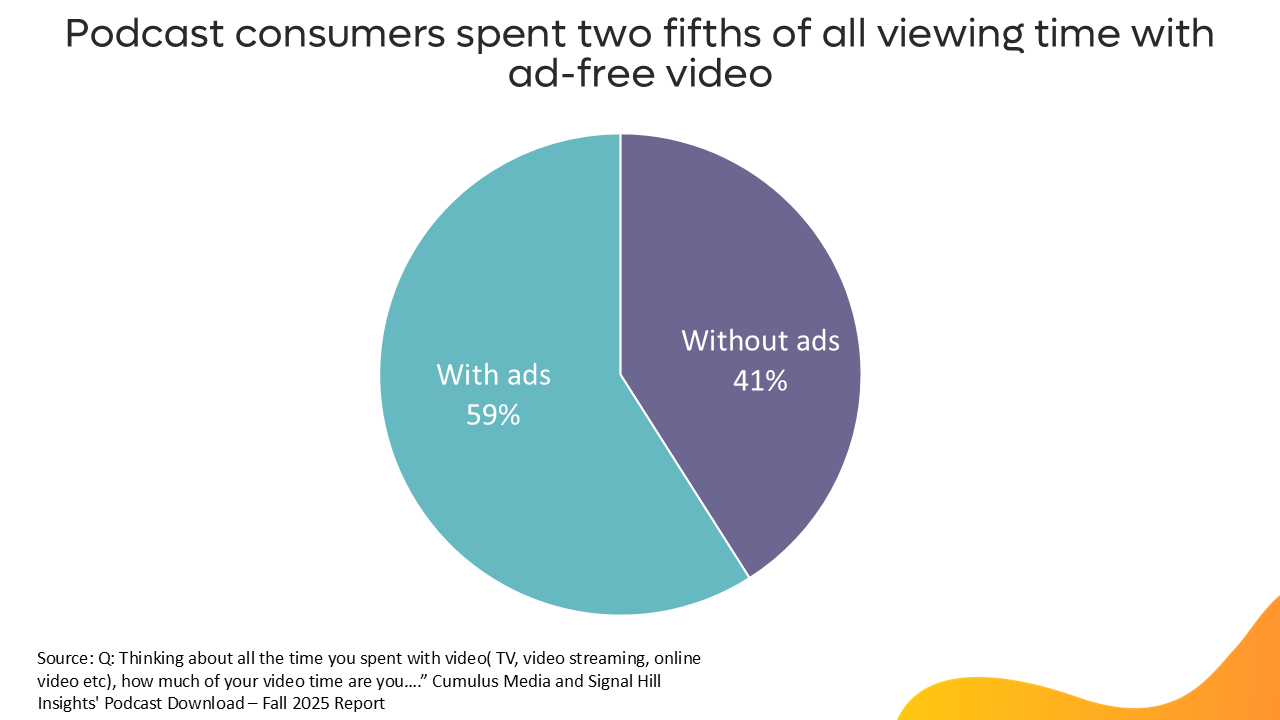
The report adds compelling evidence that podcasting reaches ad-free streaming audiences:
For podcast listeners, two thirds of tome spent with video is ad-free. Thus, podcasting provides a powerful channel for advertisers seeking incremental reach beyond linear and ad-supported video.
Summary
The 2025 report reinforces podcasting’s evolution into a hybrid audio–video ecosystem, but one where audio remains the dominant mode of consumption, even on the most video-heavy platforms. Discovery is increasingly driven by YouTube; format preferences are splitting along device and platform lines; and habits remain strong, immediate, and deeply personal. Crucially, the trust and influence of podcast hosts—combined with the medium’s ability to reach hard-to-reach audiences—positions podcasts as one of the most effective environments for modern advertising.
Click the button below to download the full report.